
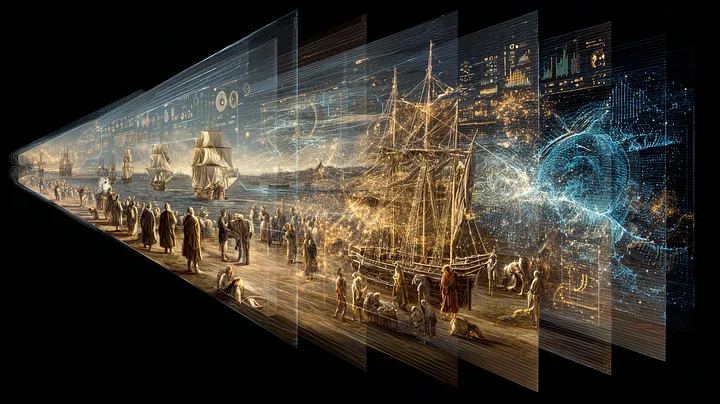
A note on the long arc of exchange, from biological mutualism to autonomous intelligence
The act of identifying a need and offering a solution through exchange is one of the older patterns in human life — older than writing, older than cities, arguably older than the species itself if you take a broad enough view of what exchange means. Long before spreadsheets and order books, living systems from plant root networks to ancient settlements operated through exchanges that propelled survival, adaptation, and growth. Trade is not an invention. It is an extension of a much older rhythm.
This piece is a brief look at that long arc — where exchange comes from, how it has accelerated over recorded history, and where the current trajectory of autonomous intelligence appears to be taking it.
The deep roots of exchange
Trade in the human sense is a recent expression of a much older pattern. Mutualistic relationships in ecosystems, fundamental forces in physics, reciprocity in human societies — these all follow the same structural shape. Entities survive and evolve by exchanging value with other entities. The specific currencies vary (nutrients, energy, information, goods, money, attention) but the underlying pattern is consistent across scales.
This is worth keeping in mind when thinking about markets specifically. Markets are not a human invention imposed on neutral material. They are a particularly intricate and recent expression of a pattern that runs through living systems generally. Understanding markets as one instance of a broader phenomenon is more useful than treating them as a peculiar feature of modern economies.
The historical arc
Human history is in many ways the story of trade. Several of the most consequential moments in the recorded past happened at trading crossroads or were driven by trade dynamics:
Around 3500 BCE, Sumerian writing emerged in part to record commercial transactions. The Code of Hammurabi formalized commercial law around 1750 BCE. The Silk Road era moved not just goods but ideas and technologies across continents. The seventeenth century saw the emergence of public markets through institutions like the Amsterdam Stock Exchange. The twentieth and twenty-first centuries have seen electronic networks collapse time and distance in trading to the point where geography is barely a constraint.
Each of these moments altered the broader trajectory of the societies involved. Trade is not downstream of civilization; it is one of the substrates from which civilization is built.
The compression of cycles
Patterns of growth, peak, and decline are woven into the fabric of human societies, and these cycles often parallel the natural environment. The Medieval Warm Period and the Little Ice Age dovetailed with eras of prosperity and hardship. Empires from Rome to the Dutch and British rose on tides of commerce and declined when conditions shifted.
What is distinctive about the last century is the rate at which these cycles have compressed. The time between expansion, dominance, and renewal has fallen from centuries to decades, and now in some domains to years. This compression is driven by instant global communication, market integration, exponential technological progress, and the increasing share of automated and algorithmic activity in market structure.
A useful data point: research on S&P 500 tenure suggests the average lifespan of a constituent company has fallen from roughly six decades in the mid-twentieth century to under two decades today. The institutions that occupy the commanding heights of any given era are not the institutions that occupied those positions a generation earlier, and the rate at which these positions turn over continues to accelerate.
For anyone working in markets, this compression is the dominant feature of the environment. Strategies that worked for years now decay in months. Edges that were structural become contested within quarters. The implication is not that nothing works, but that durability looks different than it did a generation ago.
The current stage
Computers, the internet, and now artificial intelligence have transformed trading from a human-driven activity to a primarily system-driven one. Modern markets are arenas of data flow, where the edge belongs to architectures that can perceive, reason, and act faster and more accurately than human cognition allows on the time scales that matter.
Agentic AI systems represent the most recent development in this trajectory. These are autonomous, goal-directed software components that operate continuously and adapt their behavior based on what they observe. In market contexts, agentic systems do not replace the function that traders have always performed; they extend the evolutionary arc of exchange itself by enabling participation at time scales and complexity levels that human cognition cannot reach directly.
This is not a claim that agentic systems are the end state of market evolution. It is an observation that they are the current state, and that the trajectory they are part of has been running for a long time and shows no signs of stopping.
What this implies
From mycorrhizal networks to high-frequency order flow, the story of trade is a story of increasing speed, complexity, and embedded intelligence. The interesting question is not whether this trajectory continues but what it produces at each successive stage.
The current stage appears to be one in which markets themselves are becoming adaptive substrates — coordinated less by individual decisions and more by distributed autonomous systems that perceive, reason, and act faster than the participants who built them. Whether this development is net positive depends on questions that are well beyond the scope of this piece. What seems clear is that the trajectory is real and that engaging with it seriously requires understanding what kind of phenomenon it is.
The future of markets is unlikely to be human versus machine. It is more likely to be human and machine, evolving together along a trajectory that is itself far older than either.